Best Telescopes for Beginners UK: the Pick Under £200
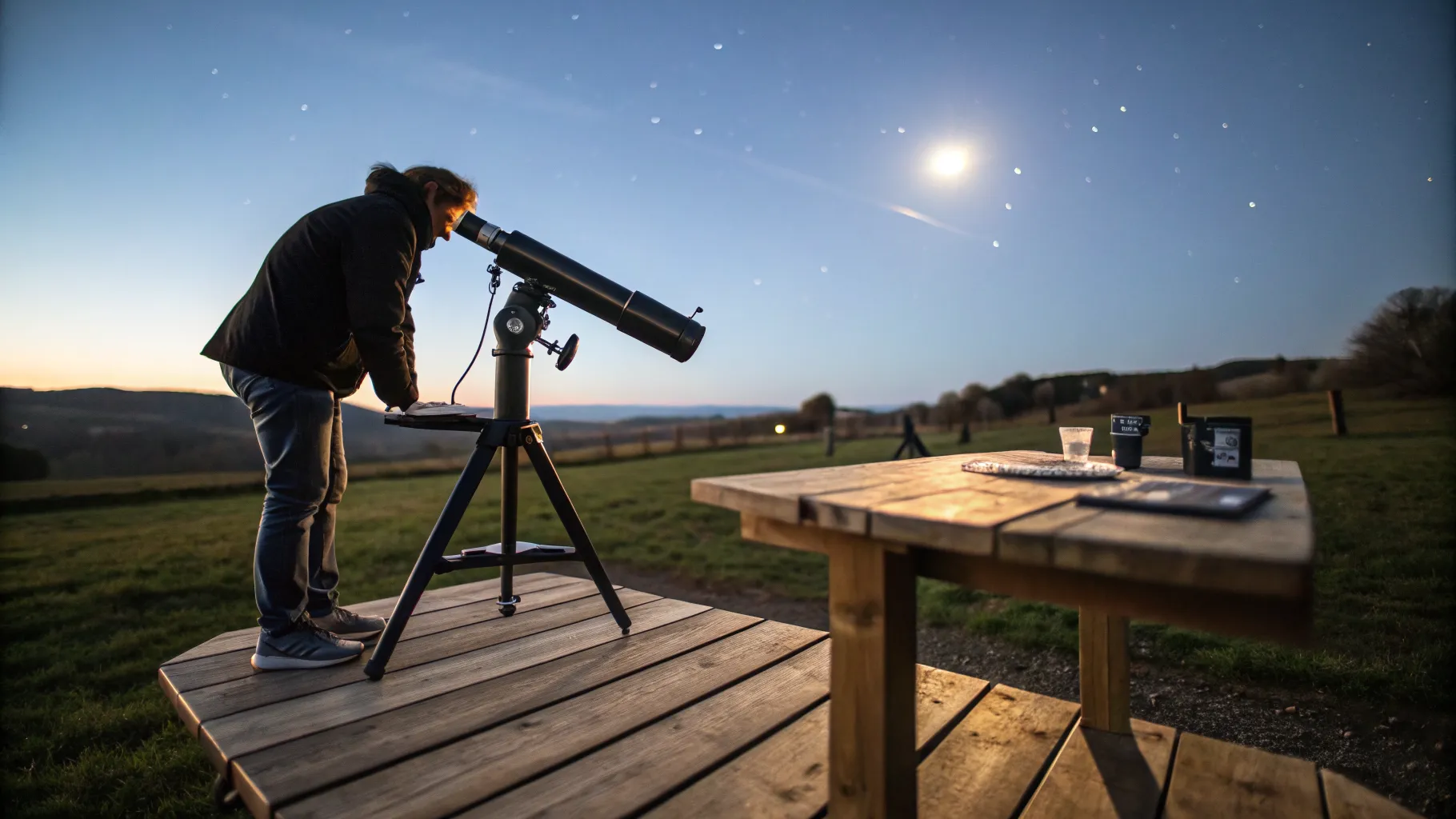
The single most common beginner mistake is buying for magnification. A box that shouts “525x power!” is almost always a small, wobbly scope that will show you a dim, blurry smudge at that magnification and put you off the hobby for good. The number that actually matters is aperture: the width of the main mirror or lens. More aperture means more light gathered, which means brighter, sharper views. Everything else follows from that.
This guide is organised by honest price bracket, with real models currently sold by UK retailers. We tell you what each bracket genuinely buys you, name the scopes worth your money, and flag the popular ones that are not, including one best seller most lists quietly recommend. Prices drift over time, so check the current price at a UK astronomy retailer such as First Light Optics or Rother Valley Optics before you buy.
The two rules that save you from buyer’s remorse
Before any model names, two principles do most of the work.
Aperture beats magnification. The useful maximum magnification of any telescope is roughly twice its aperture in millimetres. A 70mm scope tops out near 140x in real use; a 130mm reaches around 260x. A 70mm scope advertised at “525x” is selling you empty magnification, where the image just gets bigger, dimmer and fuzzier. Both Go Stargazing and Sky & Telescope make the same point: ignore the headline power figure and look at the aperture.
The mount matters as much as the optics. A good telescope on a bad mount is a bad telescope. The wobbly equatorial (EQ) tripods that ship with many budget scopes are the number one source of beginner frustration: they need polar alignment, they move on confusing diagonal axes, and they shake every time you touch the focuser. The easiest mount for a beginner is a tabletop Dobsonian. You point it where you want like a small cannon, it stays put, and there is no setup or alignment. That is why Dobsonians dominate genuine UK beginner recommendations.
Keep those two rules in mind and the brackets below make sense.
Under £100: manage your expectations
This is the bracket where most of the damage is done. The shelves of department stores and online marketplaces are full of 60mm to 70mm scopes on flimsy tripods promising “300x” or higher. Treat those claims as a warning sign, not a feature. The overwhelming forum consensus on cheap marketplace telescopes is a flat no.
You can still buy a real telescope at this level, but only if you accept its limits. Here you get the Moon in lovely detail, the brighter planets as small discs, and not much deep sky.
- Sky-Watcher Heritage-76 Mini Tabletop Dobsonian. A genuine 76mm (3 inch) reflector on a tiny tabletop Dob base. This is the honest entry-level pick: a real instrument at toy-telescope money. It shows the Moon’s craters, Jupiter as a disc with its moons, and Saturn’s rings as a hint. It will not show galaxies, and that is fine for the price.
- Sky-Watcher Capricorn 70 EQ1. A 70mm f/12.9 refractor on a small equatorial mount. The optics are decent for the Moon and planets, but the EQ1 mount is the weak point: wobbly and fiddly for a complete beginner. Worth knowing before you order.
- Bresser Solarix 76/350. A 76mm reflector sold in the UK, a reasonable budget all-rounder in the same class as the Heritage-76.
If your budget is firmly at the bottom and you want one recommendation, it is the Heritage-76. If you can stretch, the next bracket is where almost every experienced stargazer will tell you to spend.
£100 to £200: the sweet spot
This is where the value lives and where most serious UK editorial recommendations cluster. For not much more than the budget bracket, you cross into telescopes that show real structure: Jupiter’s cloud belts, Saturn’s rings clearly separated from the planet, the Orion Nebula as a glowing cloud, and dozens of star clusters.
Sky-Watcher Heritage-130P Flextube Tabletop Dobsonian is our lead recommendation and the single most-recommended UK first telescope for good reason. It is a 130mm (5.1 inch) parabolic reflector with a 650mm focal length (f/5) on a collapsible flextube tube that shrinks from about 25 inches down to 14.5 inches for storage and transport. It weighs around 6.2kg, comes with 10mm and 25mm eyepieces plus a red-dot finder, needs no alignment, no batteries and no setup, and the push-to-point Dobsonian base is the friendliest mount a beginner can use. Pop it on a garden table or a low wall, point, and look. It shows everything the brackets below promise, just slightly smaller and dimmer than a 150mm.
Other models in this band:
- Sky-Watcher Heritage-100P Tabletop Dobsonian. A 100mm (4 inch) f/4 version of the same idea, lighter at about 2.8kg and cheaper. A solid step up from the entry-level scopes with the same no-setup convenience. Choose this over the 130P only if budget or weight is tight.
- Celestron StarSense Explorer LT 70AZ. A 70mm refractor on a manual alt-azimuth mount with a clever twist: it docks your smartphone and uses an app that reads the star field through your phone camera and shows you exactly where to push the scope to land on a target. BBC Sky at Night Magazine rates it a strong budget beginner pick. The trade-off is the small 70mm aperture, so views are dimmer than the 130P. It suits total novices who want the tech to do the finding for them.
- Sky-Watcher Skyhawk 114 and Explorer 130 EQ2. Capable optics, but both sit on equatorial mounts that add the complexity the Heritage Dobsonians avoid. Pick these only if you specifically want to learn an EQ mount.
If you buy nothing else from this guide, the Heritage-130P is the safe answer to “what is the best telescope for beginners under £200.”
£200 to £300: buy once, more light
Spend into this bracket and you are paying mostly for aperture, which is the upgrade that actually changes what you can see.
- Sky-Watcher Heritage-150P Flextube Tabletop Dobsonian is the “buy once” pick. A 150mm (6 inch) f/5 collapsible Dob, around 7.5kg, with noticeably more light grasp than the 130P while keeping the same no-setup tabletop convenience. Faint galaxies and nebulae start to show real shape. If you suspect you will stay in the hobby, this is the scope to grow into.
- Sky-Watcher StarQuest DX130P. A 130mm f/5 Newtonian on a small mount, around 8kg, for those who want a tripod-mounted option rather than a tabletop.
- Celestron StarSense Explorer DX 100 AZ. A 100mm refractor with the same smartphone-guided StarSense app as the LT 70AZ, badged in partnership with the Royal Observatory Greenwich. Good if you liked the StarSense idea but want more aperture.
The popular scope to skip: Celestron AstroMaster 130EQ
The AstroMaster 130EQ is one of the best-selling beginner telescopes in the UK, and it is worth naming honestly because most lists either praise it or stay quiet. It is a 130mm f/5 Newtonian on a CG-3 equatorial mount, roughly 12kg as a kit, with 20mm and 10mm eyepieces and a red-dot finder.
Three problems make it a poor first scope:
- Some units ship with a spherical primary mirror rather than a parabolic one, a cost-cutting substitution that softens the image at higher magnifications.
- The supplied 20mm eyepiece is widely criticised as poor quality.
- The equatorial mount is exactly the kind of fiddly setup that frustrates beginners.
Reviewers such as Telescopic Watch list it as “Not Recommended” and steer buyers to the Heritage-130P at similar money. We agree. For the same outlay you get a better mount and a parabolic mirror in the Sky-Watcher. The Heritage 130P versus AstroMaster 130EQ question comes up constantly on forums, and the Heritage wins on every count that matters to a beginner.
£300 and up: smart telescopes (read this first)
This bracket is dominated by “smart telescopes,” and they work in a fundamentally different way. You do not look through an eyepiece. The scope points itself, takes a stream of short exposures, stacks them, and shows the result on your phone or tablet. They are astrophotography and electronically assisted astronomy (EAA) devices, not visual scopes. That can be magical for capturing colourful nebulae from a light-polluted garden, but if your mental image of stargazing is putting your eye to an eyepiece, manage your expectations.
- ZWO Seestar S30. A 30mm f/5 apochromatic all-in-one smart scope on a motorised alt-azimuth base, with an S30 Pro variant above it. One of the most affordable smart telescopes on the UK market.
- ZWO Seestar S50. A 50mm triplet apo with a 250mm focal length, the same smart-imaging concept with a larger aperture.
- Celestron StarSense Explorer 130mm tabletop Dob. Worth a mention here as a visual alternative if you want aperture and eyepiece viewing in this price area rather than a phone screen.
A Seestar is a brilliant gadget and a genuinely good route into imaging. Just buy it knowing what it is. If you want to learn the sky by eye, a Heritage-130P or 150P will teach you more.
What you’ll actually see from a UK back garden
A worry that stops a lot of urban buyers: does light pollution make a telescope pointless? For the things beginners most want to see, no. Planets and the Moon are bright enough to cut straight through city skyglow. Jupiter’s belts and four big moons, Saturn’s rings, the phases of the Moon and its craters all look essentially the same from a Manchester terrace as from a dark field. You do not need to leave town for those.
Where light pollution bites is deep sky: galaxies and faint nebulae. From a typical town you might see around 200 stars; from a proper dark-sky site that can rise to around 3,000. The UK’s first International Dark Sky Park was Galloway Forest Park, designated in 2009, and a trip to a site like that transforms what a modest telescope can show. For everyday use, though, the planets alone justify the purchase from any back garden.
Which type of telescope: a quick decision guide
| If you want… | Buy this type | Example |
|---|---|---|
| The easiest possible start, best value | Tabletop Dobsonian (reflector) | Heritage-130P / 150P |
| The most light for your money | Larger Dobsonian | Heritage-150P |
| Tech to find targets for you | Refractor with smartphone app | StarSense Explorer LT 70AZ |
| To photograph nebulae from a town | Smart telescope (EAA) | ZWO Seestar S50 |
| A scope that never needs collimation | Refractor | Capricorn 70, StarSense refractors |
One maintenance note for the reflectors above, including the Heritage and AstroMaster scopes: they occasionally need collimation, which is aligning the mirrors. It sounds intimidating and is not. It takes a few minutes with a cheap collimation cap once you have watched a short video, and you will not need to do it often. Refractors and Maksutov scopes never need it, which is one reason the StarSense refractors suit the least hands-on buyers.
Where to buy in the UK
Stick to specialist UK astronomy retailers rather than general marketplaces. First Light Optics, Rother Valley Optics and the Widescreen Centre stock the models above, give honest advice, and handle warranty properly. Avoid US-focused “best telescope” lists that recommend the Apertura AD6, AD8 or Starbase scopes; those are not stocked in the UK and the prices quoted will be in dollars.
If you can, visit a local astronomy society before spending. Most run free public observing evenings where you can look through several scopes and ask what their owners would buy again. The forum truism holds: the best telescope is the one you will actually use, and the only way to know what that is for you is to try a few.
Frequently asked questions
What is the best telescope for a beginner under £200? The Sky-Watcher Heritage-130P Flextube tabletop Dobsonian. It needs no setup or alignment, gives 130mm of aperture, and shows Jupiter’s belts, Saturn’s rings and the Orion Nebula. It is the most-recommended UK first telescope and the safe answer in this price range.
Heritage 130P or AstroMaster 130EQ, which is better? The Heritage 130P, clearly. Both are 130mm reflectors at similar money, but the AstroMaster sits on a fiddly equatorial mount, ships a poor 20mm eyepiece, and some units come with a cheaper spherical mirror. The Heritage gives you a friendlier mount and a parabolic mirror for the same outlay.
Can I see Saturn’s rings and planets with a cheap beginner telescope? Yes. Even a 76mm scope shows Saturn’s rings as a clear shape and Jupiter’s four big moons. A 130mm shows the rings separated from the planet and Jupiter’s cloud belts. Planets are bright, so they work from a city garden and do not need dark skies.
Does light pollution from a UK city ruin a telescope? Not for the Moon and planets, which are bright enough to cut through skyglow and look the same from a city as from the countryside. Light pollution does dim faint galaxies and nebulae, so for those you will want a darker site or a light-pollution filter.
Do I need a table for a tabletop telescope? Yes, a tabletop Dobsonian needs a stable surface at a sensible height: a garden table, a sturdy stool, a wall or even a flat-topped bin will do. Some owners buy a separate flat-topped tripod or a low platform, but you do not need an expensive mount.
Are smart telescopes like the ZWO Seestar good for beginners? They are excellent for capturing images of nebulae and galaxies from a light-polluted garden, and they point themselves. The catch is that you view everything on a phone or tablet rather than through an eyepiece. If you want the classic look-through-the-eyepiece experience, a Dobsonian is the better first scope.
What magnification do I need for a beginner telescope? Less than the box claims. Useful maximum magnification is about twice the aperture in millimetres, so a 130mm scope is good to roughly 260x and a 70mm to about 140x. Most of the best views happen between 30x and 150x. Ignore any scope advertising “525x” or similar as its headline feature.
Which of these is the best telescope for a child? The same aperture-first rule applies, but weight and simplicity matter more, so a lightweight tabletop Dobsonian a child can carry and point unaided wins over a fiddly tripod mount. We cover the specific models, ages and budgets in our best telescope for kids guide.
Clear skies forecast? Get a nudge.
Our weekly email flags the next good UK observing window and one easy target to find.
Join the listMore from Starvest
Keep reading
What Can You See with Binoculars at Night? A Realistic Astronomy List
A realistic list of what you can see with binoculars in astronomy, from the Moon and Jupiter's moons to Andromeda, with tips for spotting each from the UK.
How to Set Up and Use Your First Telescope (Step by Step)
How to use a telescope as a beginner: assemble the mount, align the finder, focus, and find your first targets. A clear step-by-step UK guide.
How to Collimate a Telescope (Newtonian Reflector)
How to collimate a telescope step by step, aligning a Newtonian reflector's mirrors with a collimation cap, Cheshire or laser for sharp views.