Seestar S30 vs S50 vs Dwarf 3: Which Smart Telescope Should You Buy?
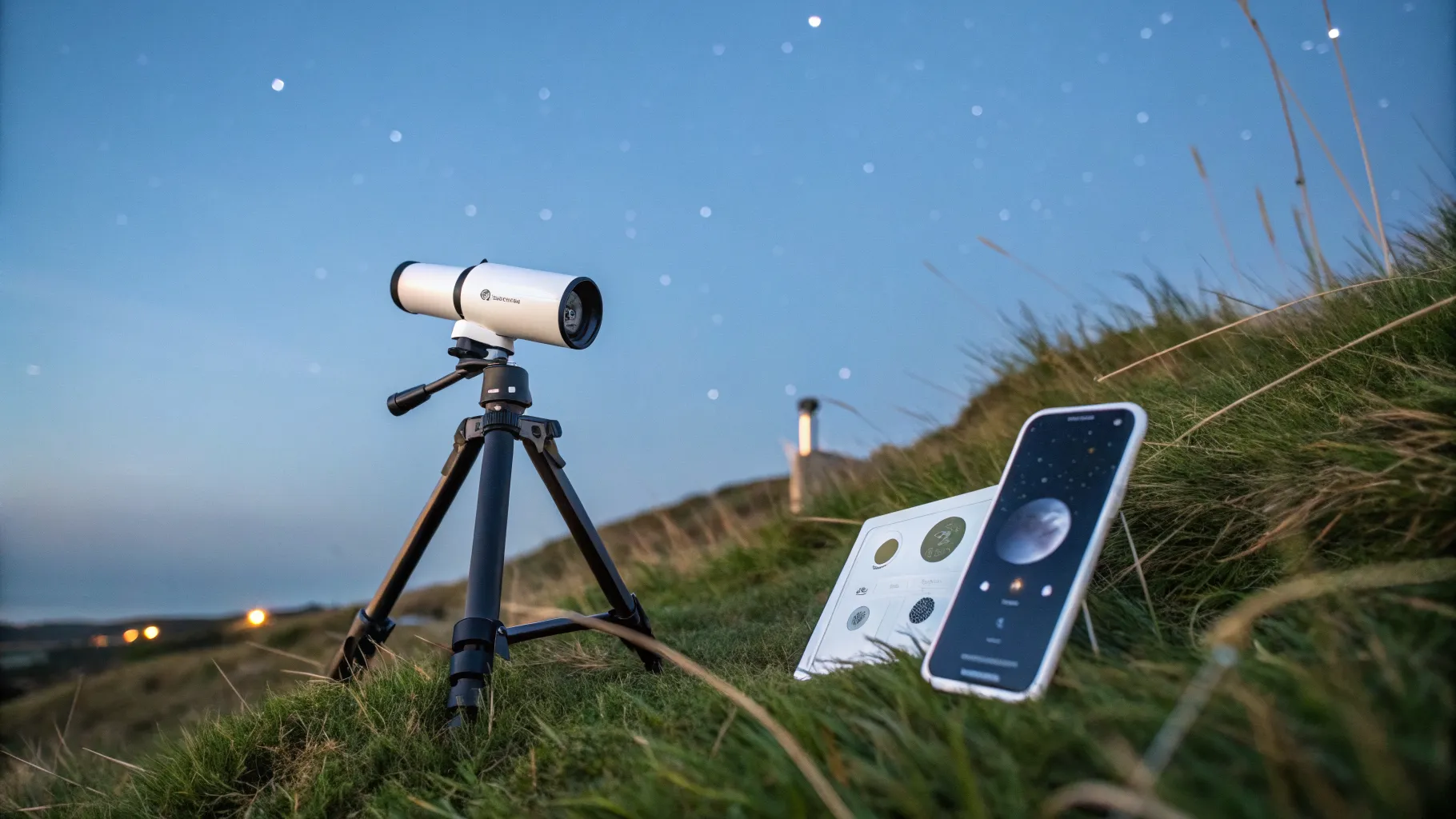
Smart telescopes have changed who gets to do astrophotography. Instead of polar aligning a mount in the cold and fiddling with a laptop, you set a small box on a tripod, open an app, tap a target, and watch a nebula slowly build up on your phone screen. For a UK beginner sitting under cloudy, light polluted skies, that shift matters more than almost any spec on the box.
Three models dominate the conversation in 2026: the ZWO Seestar S30, the ZWO Seestar S50, and the DwarfLab Dwarf 3. This guide compares them on the things that actually decide which one you should buy: optics, portability, what you can realistically photograph, and price. There is also a fourth name worth knowing, the newer Seestar S30 Pro, which slots in above the S30, so it gets a mention too.
The short answer
If you want a single recommendation before the detail:
- Buy the Seestar S30 if you want the lowest cost route into the hobby, the simplest app, and a telescope light enough to carry anywhere. It is the easiest first telescope for a curious newcomer or a parent buying for a child.
- Buy the Dwarf 3 if you also care about wide nightscapes, the Milky Way over a landscape, and daytime use, and you do not mind learning a slightly busier app.
- The Seestar S50 still has the largest aperture and the best fine detail on small targets like galaxies, but ZWO has stopped producing it and a S50 Pro is due later in 2026, so think twice before paying full price for the remaining stock.
The rest of this guide explains why.
What a smart telescope actually does
All three units are sealed, all in one devices. Inside each is a small refractor lens, a sensitive camera sensor, a motorised mount, a focuser, and a computer running plate solving software. You connect by WiFi from a phone or tablet, pick an object from a built in database, and the telescope swings to it, focuses, and starts taking a series of short exposures.
The clever part is live stacking. Rather than one long exposure, the device captures dozens or hundreds of short frames and stacks them in real time, adding signal and averaging out noise. Each minute, the image of a nebula or galaxy gets a little cleaner on screen. This is also why these scopes cope with light pollution far better than you would expect. A dual band light pollution filter, built into the Seestar models, blocks much of the broad orange glow from streetlights while letting through the specific wavelengths that nebulae emit. People living in Bortle 6 suburban skies routinely pull deep sky detail out of their back gardens with one of these.
You do not look through any of them with your eye. There is no eyepiece. If watching a target appear on a screen sounds like cheating to you, a traditional telescope is the better fit. For everyone else, the convenience is the whole point.
Seestar S30: the easy, light, cheap one
The S30 is the model most UK beginners should look at first. It pairs a 30mm f/5 apochromatic lens, a triplet design that uses an ED glass element to control colour fringing, with a 150mm focal length and a Sony IMX662 Starvis 2 sensor. It weighs around 1.65kg, carries 64GB of onboard storage, and runs for roughly six hours on a charge.
That short 150mm focal length gives a wide field of view, which is its quiet strength. Big targets like the Andromeda Galaxy, the Orion Nebula, the North America Nebula, and the Pleiades fit comfortably in frame. The wide field is also forgiving: framing errors and slight tracking imperfections are less obvious than they would be on a longer scope.
At around £419 in the UK from specialist retailers such as First Light Optics, it is the cheapest credible smart telescope on the market. For a child’s first telescope, or for an adult who wants to try the hobby without a large outlay, it hits the sweet spot of price, weight, and simplicity. The trade off is resolution. The 2 megapixel sensor and modest aperture mean small objects like distant galaxies stay small, and you cannot crop in hard without the image falling apart.
There is now a step up model, the Seestar S30 Pro, at around £649. It keeps the compact 30mm body but adds a 160mm f/5.3 quadruplet apochromatic lens, larger 4K capable Sony IMX585 and IMX586 sensors, and 128GB of storage. If your budget stretches and you want noticeably more detail and resolution from the same pocketable form factor, the Pro is the one to compare against the Dwarf 3 rather than the standard S30.
Seestar S50: the most aperture, but on its way out
The S50 is the original that made ZWO’s name in this category. It has the biggest lens of the group, a 50mm f/5 triplet apochromat with a 250mm focal length. More aperture gathers more light, so on a given target the S50 builds a cleaner stacked image faster, and the longer focal length puts more pixels on small objects. For galaxies and tighter framing, it produces the most detailed results of the three.
The catch is practical. The S50 is heavier at around 2.5kg for the telescope, and crucially, ZWO has confirmed it has ended production. Several UK retailers now list it as unavailable, and the company has signalled a Seestar S50 Pro arriving later in 2026. Paying the full £539 or so for the outgoing model, when a successor is months away, is a hard recommendation to make in 2026. If you find one heavily discounted and you specifically want maximum reach on small targets today, it remains a capable instrument. Otherwise, wait for the Pro or pick one of the others.
Dwarf 3: the versatile dual lens option
DwarfLab’s Dwarf 3 takes a different approach. It carries two lenses: a 35mm telephoto with a 150mm native focal length, and a separate wide angle lens with a 45 degree field of view. The telephoto reports a long equivalent focal length once you account for the small sensor and crop modes, which lets it reach for tighter deep sky targets, while the wide lens opens up landscape astrophotography, the Milky Way arching over a horizon, timelapses, and even daytime shooting.
Behind both lenses sits a Sony IMX678 Starvis 2 sensor, a strong low light performer. The unit is the lightest here at about 1.3kg, carries a generous 128GB of storage, and has a 10,000mAh internal battery that held up for over four hours in near freezing conditions during one published test. It also offers an equatorial tracking mode that reduces field rotation on long sessions, which helps keep stars round on big targets like Andromeda.
BBC Sky at Night Magazine scored the Dwarf 3 four out of five, praising its battery life, its image quality over the older Dwarf II, and consistent Go To performance, while noting the wide angle lens focus is not quite ideal for critical astrophotography. UK pricing sits around £465 at specialist retailers.
The Dwarf 3 suits the buyer who wants more than deep sky framing alone. If you imagine yourself photographing the Milky Way over a beach as much as a galaxy, the dual lens flexibility is genuinely useful. The cost is a slightly busier app and a marginally steeper learning curve than the Seestar.
Quick comparison
- Seestar S30: 30mm f/5, 150mm focal length, IMX662 sensor, ~1.65kg, 64GB, around £419. Best for: easiest, cheapest entry; wide field targets; children and first timers.
- Seestar S30 Pro: 30mm f/5.3 quadruplet, 160mm, IMX585 plus IMX586, ~1.65kg, 128GB, around £649. Best for: more resolution in the same small body.
- Seestar S50: 50mm f/5, 250mm focal length, IMX462 sensor, ~2.5kg, around £539. Best for: maximum detail on small targets, but discontinued and being replaced.
- Dwarf 3: 35mm telephoto plus wide angle, 150mm native, IMX678 sensor, ~1.3kg, 128GB, around £465. Best for: nightscapes, Milky Way, daytime versatility.
Prices move and stock changes, so always confirm the current figure with a UK specialist retailer before buying.
It still helps to get under a dark sky
A smart telescope will pull deep sky objects out of a light polluted garden, but it cannot perform miracles, and it does nothing for the experience of simply standing under a truly dark sky. The Bortle scale, devised by amateur astronomer John Bortle and published in Sky & Telescope in 2001, runs from Class 1 for the darkest possible sky to Class 9 for an inner city sky. You generally need Bortle 4 or darker to see the Milky Way clearly with the naked eye.
The UK has a network of certified dark sky places where that is possible, including reserves at Exmoor, the Brecon Beacons, Snowdonia, the North York Moors and the Yorkshire Dales, plus Galloway Forest Park in southern Scotland. You can find the certified list on the DarkSky International UK page. Taking any of these telescopes to a Bortle 3 site, even for one clear night, will show you what they can really do. For more on planning a trip and reading the scale, see our guide to dark sky sites in the UK.
Frequently asked questions
Which is the best smart telescope for a complete beginner in 2026? The Seestar S30 is the easiest and cheapest entry point at around £419. Its app is the simplest of the group, it is light enough to carry anywhere, and its wide field of view is forgiving of small framing and tracking errors, which makes early sessions less frustrating.
Can I use a smart telescope from a city or back garden? Yes. Live stacking combines many short exposures and averages out noise, and the Seestar models include a dual band light pollution filter that blocks much of the orange streetlight glow. Users in Bortle 6 suburban skies regularly capture nebulae and galaxies from home. Darker skies still give cleaner results, but you do not need them to start.
Should I wait for the Seestar S50 Pro instead of buying the S50? If your priority is the largest aperture and most detail on small targets, it is worth waiting. ZWO has ended production of the original S50 and confirmed a S50 Pro arriving later in 2026. Paying full price for discontinued stock months before a successor lands is hard to justify unless you find a steep discount.
What is the difference between the Seestar S30 and the Dwarf 3? The S30 is a single lens scope focused on simplicity and a wide deep sky field. The Dwarf 3 carries two lenses, a telephoto for deep sky and a wide angle for Milky Way landscapes, timelapses and daytime shots, plus an equatorial tracking mode. The Dwarf 3 is more versatile, the S30 is simpler and cheaper.
Do you look through these telescopes with your eye? No. None of them have an eyepiece. You view everything live on a phone or tablet over WiFi as the image stacks. If looking through a telescope by eye is important to you, a traditional optical telescope is a better fit.
How much should I budget all in? Plan for the telescope plus a few extras. The S30 starts around £419, the Dwarf 3 sits around £465, and the S50 is around £539, with the S30 Pro near £649. Budget a little more for a power bank for longer sessions, a sturdy carry bag if one is not included, and ideally a phone or tablet you are happy to leave outside in the cold.
Clear skies forecast? Get a nudge.
Our weekly email flags the next good UK observing window and one easy target to find.
Join the listMore from Starvest
Keep reading
Best Telescopes for Beginners in the UK (Tested by Price Bracket)
The best beginner telescopes in the UK by budget, from sub-£150 tabletop scopes to app-guided and smart telescopes, with real 2026 prices.
What Can You See with Binoculars at Night? A Realistic Astronomy List
A realistic list of what you can see with binoculars in astronomy, from the Moon and Jupiter's moons to Andromeda, with tips for spotting each from the UK.
How to Set Up and Use Your First Telescope (Step by Step)
How to use a telescope as a beginner: assemble the mount, align the finder, focus, and find your first targets. A clear step-by-step UK guide.